 Genes on the Web
- Birth*: Theodore Napier FSA 3rd son was born on 29 March 1845 at Melbourne, Australia,
 .1
.1 - He was the son of Thomas Napier carpenter to Australia and Jessie Paterson.1
- (Deceased) Death*: Theodore Napier FSA 3rd son died on 29 August 1924 at age 79.1
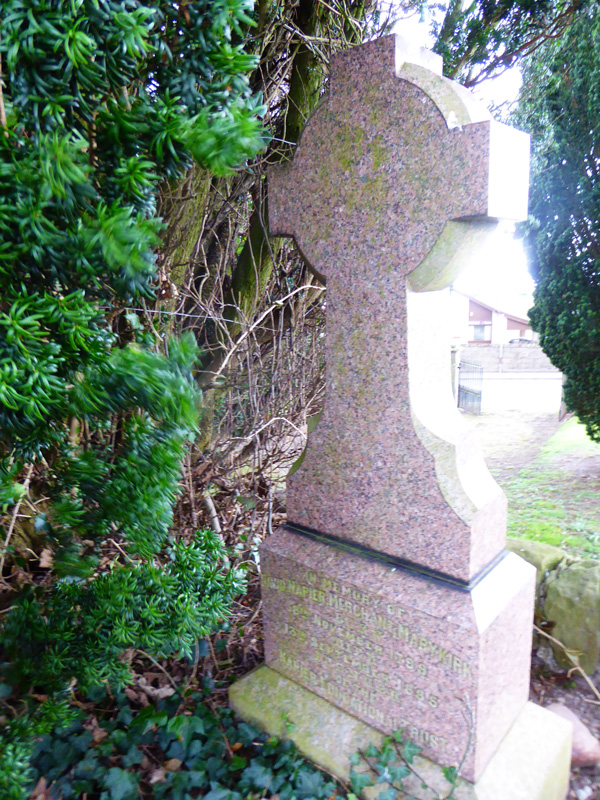
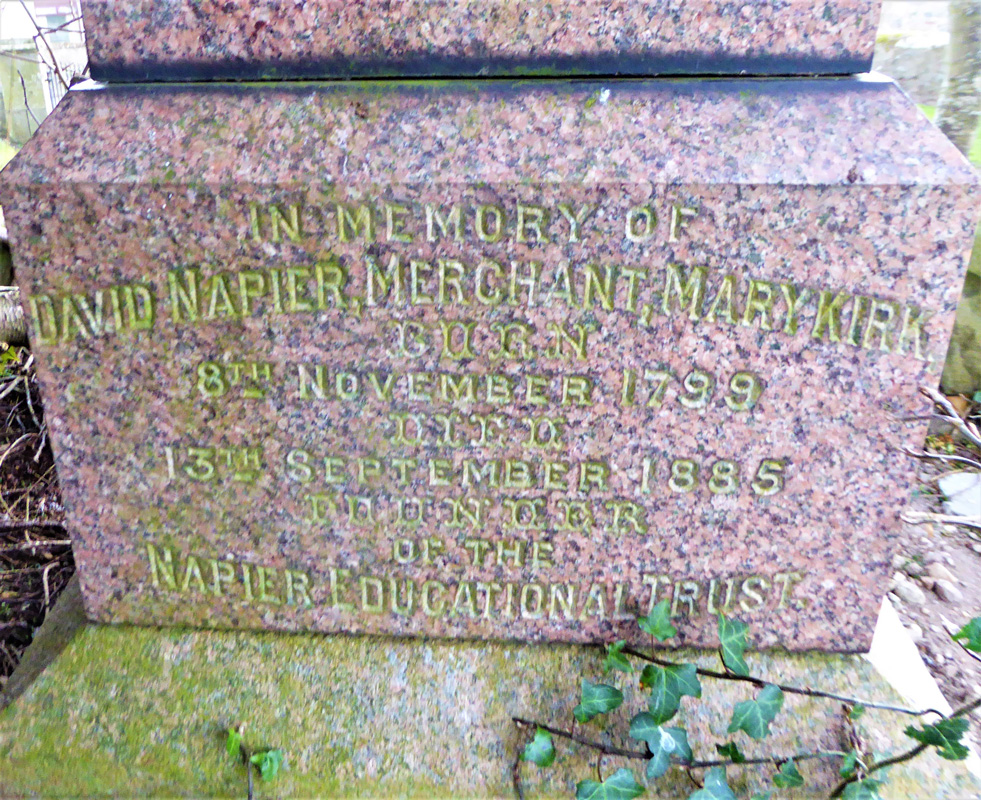
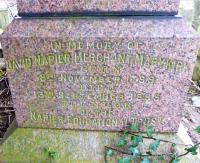
- (Witness) Memorial Inscription: He is commemorated on the headstone erected after 13 September 1885 at Marykirk Kirkyard, Aberdeenshire, Scotland. Inscription reads Son of James Napier, weaver & Margaret Sutor
Founder of the Napier Educational Trust
David Napier served an apprenticeship in his village as a joiner, he went to London when he became unwell and became a Grocer at home. He was unmarried and concerned about local school children walking to school in the cold weather.
In his will he set up funding for a new school, the total amount was 3,500 pounds that was raised for a mixed school in a closer location, as many of the students lived at least 3 miles away from public school. Initially David Napier allocated funds for a school with a male teacher, however additional funds were sourced to cover the full amount and a female teacher was installed.
The school opened on a sunny Saturday in 1898 with the royal standard and other flags flying out the front, presented by David Napier's nephew Theodore Napier. A temporary platform was installed at the west end of the school where the many trustees of the school, (who included Theodore Napier were seated)
Mr W C Carnegie of Marykirk was the architect, Chipping Norton of Marykirk prepared the plans. Mr William Greig was the builder, Alexander Dunbar was the Carpenter, Charles Brand the Slater, Mr Hood the Plasterer and Colin Wood and Co., the plumber.
The Chairman gave a speech and presented to Theodore Napier a silver trowel as a momento of their meeting. The inscription read;
Presented to Theodore Napier Esq., on the occasion of his laying the foundation stone of the 'Napier Memorial School', Marykirk on the 9th July, 1898.
As a part of his reply Theodore Napier announced that it had been his personal fortune or misfortune to have been born in the British Colony of Australia, however every drop of his blood was Scottish. He would never forget his happy days in Marykirk. He lamented with affection on David Napiers' love of children.
The memorial stone is at the front of the main entrance to the school.
Napier Memorial School was opened in 1898 and was erected by the Trustees of David Napier. It was leased to the Education Authority of Kincardine in 1920 and transferred to them in 1935. The school became known as Napier Primary School and closed in 1968 with the pupils transferring to Marykirk School.2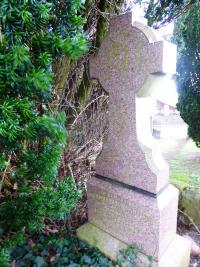
- Newspaper Article: He and Jessie Paterson were mentioned in a newspaper article THE WALLACE STATUE IN ABERDEEN. WHAT WALLACE ACHIEVED FOR HIS COUNTRY.
We have received a letter from a Montrose lady resident in Australia, enclosing one from Mr Theodore Napier, to show, she says, "how
Scotland is venerated at this side of the equator. Mr Napier is the son of Mr Thomas Napier (late of Marykirk) who came out over fifty years ago. Napier, of Magdala (the name of his beautiful home) was educated in Edinburgh, which has made him true Scot. The letter, which is dated 9th June, 1888, is as follows:
"I was much pleased to receive your letter enclosing a print of the Wallace statue for Aberdeen It is very good on the whole. I like the attitude, but I think the features are rather too old for Wallace, who was less than forty when slain by Edward. I think very highly of the Aberdeen people for raising such a memorial to their (and our) noble patriot here - the man who, against the mightiest odds, determined to stand for Scotland's freedom. Never would he bow to England's king. Rather than do so, he would bow his hand to the executioner’s sword. If he did not succeed in freeing Scotland from English tyranny it was from no fault of his; he did all that a brave, devoted man could possibly do. The fault lay with the half-hearted nobility, who, rather than see Wallace achieve a victory, would desert the standard of their country and play like traitors into the hands of their country's enemy. Scotland owes but little to her nobles. God has raised in "Auld Scotia", a “brave peasantry, their country's pride," and it is this brave peasantry who nobly stood by Wallace and fought for Scotland's freedom. Wallace paved the way for Bruce and Bannockburn. Wallace lighted the fire which was never extinguished until everyEnglishman was driven out of Sootland, and Scotland's Lion floated over the ramparts of every castle north of the Tweed. I would like to see Scotsmen all over the world revive the national spirit, and celebrate the day they owe so much to – I mean, of course, Bannockburn. I would like them to commemorate the glorious victory achieved on that memorable day, the 24th June, 1314, and show to the world that they had not quite lost all the gratitude due to their great ancestors, who resolved on that day either to “do or die.” I intend myself having a little celebration on the 24th June-probably a bonfire and fireworks, with a display of our national flags. We shall be very pleased indeed to see you out to stay a few days then if convenient." on 27 July 1888 at Montrose, Forfarshire, Scotland,.3 - (Informant) Death: Theodore Napier FSA 3rd son registered the death of Jessie Paterson on 28 August 1890 at Rosebank, Farendon, Melbourne, Victoria, Australia, ; Napier - on the 28th inst., at her residence, Rosebank, Farendon, Jessie, relict of the late Thomas Napier; and mother of Mr T Napier, Magdala, Farendon, and of Mrs G P Barber, of Staywoodpark, Warrnambool, aged 74 years. A Colonist of 54 years.1,4
- Newspaper Article*: Theodore Napier FSA 3rd son was mentioned in a newspaper article MARYKIRK.
QUEEN'S DIAMOND JUBILEE.-There has as yet been no meeting here in connection with the Jubilee celebrations, but Mr Theodore Napier, F.S.A., Edinburgh, who is well known as a most enthusiastic Scotchman, has promised to present to the village for the occasion, and to be used on gala days, a royal Scotch standard-lion rampant on yellow ground. The only stipulation in con- nection with the gift is that the flag be hoisted every 24th day of June-"Bannockburn Day." It may be mentioned that Mr Napier's father was a native of Marykirk, and his uncle was Mr David Napier, whose name appeared last week in our columns as the founder of the Napier Institute. Mr Napier's promised gift has given great satisfac- tion to the villagers. on 26 March 1897.5 - Newspaper Article*: He and David Napier merchant, founder of Napier Educational Trust were mentioned in a newspaper article MARYKIRK.
NAPIER MEMORIAL SCHOOL.-At a meeting yesterday of the trustees of the late David Napier it was arranged that the foundation stone of the school should be laid on the afternoon of Saturday, 9th July. It is reported that it will be laid by Mr Theodore Napier, Edinburgh, a nephew of the truster. on 24 June 1898 at Montrose, Scotland,.6 - Newspaper Article: Theodore Napier FSA 3rd son was mentioned in a newspaper article INTERESTING GATHERING
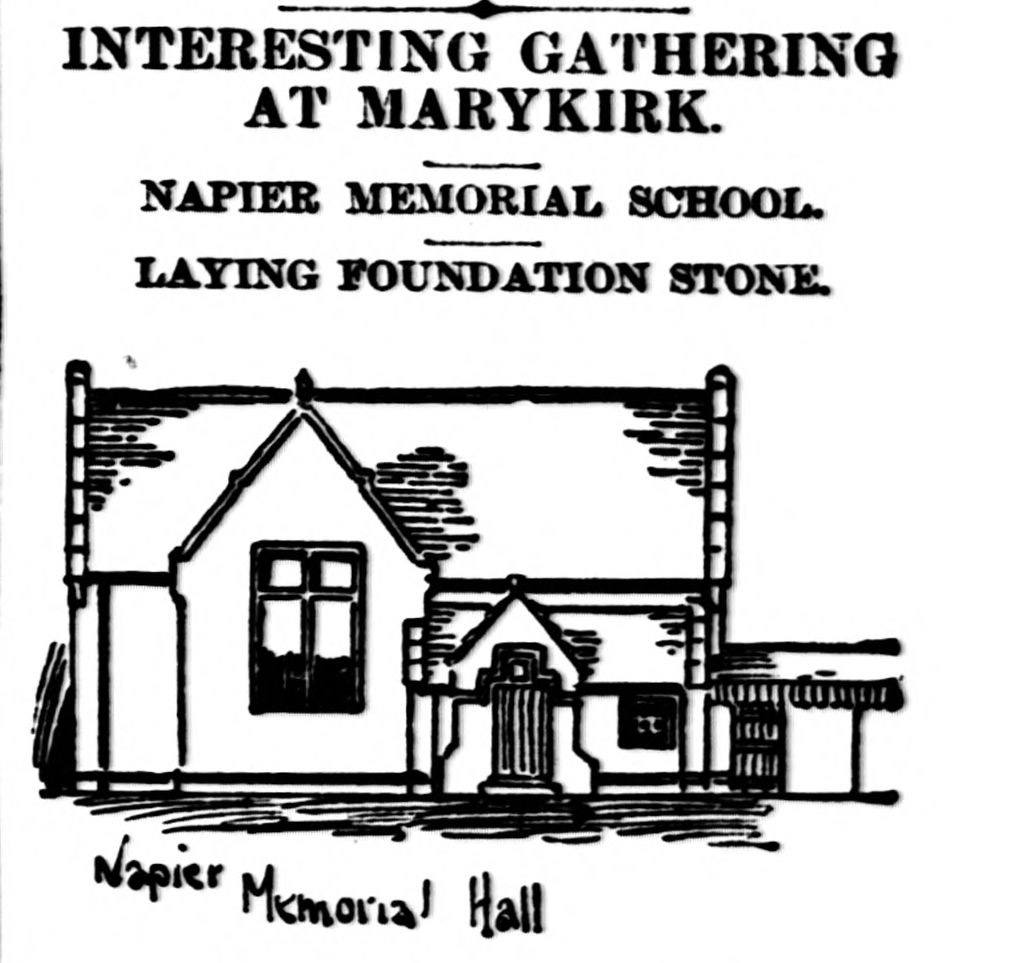
AT MARYKIRK.
NAPIER MEMORIAL SCHOOL. LAYING FOUNDATION STONE
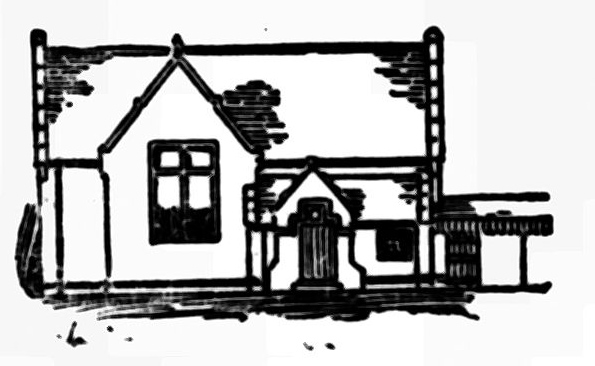
Napier Memorial Hall
A very interesting function came off at Mary kirk on Saturday afternoon, when the foundation stone of the new Napier Memorial School was laid by Mr Theodore Napier, nephew of the donor. The money for the building of the school, which is intended for the education of the infants and first standards only, was left some years ago by Mr David Napier, at one time a grocer in the village, and one who took a practical interest in the welfare of the young of the parish. The money has since been left to accumulate, and now a sufficient sum has accrued for the building of the school. Special interest was attached to Saturday's ceremony on account of the presence of the well-known Scottish patriot, Mr Theodor Napier, who attended in true Highland garb. Among those present were:-Rev. Mr and Mrs M'Clure, Parish Church, Marykirk; Mr. Mrs, and Miss Peace, Schoolhouse, Marykirk; Mr and Mrs Hood, Laurencekirk; Mr and Mrs Young, Fitgarvie; Mr D. Japp, Newton; Mr Charled Anton, Shanghai, and Miss Anton, Arbroath Professor and Mrs and the Misses Blyth, Glas gow; Mr Balfour, Montrose; Mr Arthur Dick st, solicitor, Montrose; Dr Duffus, Marykirk Mr Dickson, jun., Montrose; Rev. Mr and Mr Scott, Laurencekirk; Mrs and Miss Rae, South Barns; Mr G. K. E. Napier, Montrose; Mr Wm. Carnegie, factor for Earl of Ducia; Mrs Thos Napier and Mrs Jas. Napier, Stonehaven; MP George K. E. Napier, Montrose; Rev. Jas. Land reth, Logie Pert; Rev. Mr Mitchell; Mr Lang headmaster, Laurencekirk; &c.
Rev. Mr M'Clure, Established Church, Mary kirk, presided, and read several apologies for absence. He said it was gratifying that in thi country now and again individuals were found of substantial means who were disposed to think effectively of the needs of others. (Applause.) The trustees had carefully husbanded the money left by Mr Napier, until now it amounted to 12500(applaus)-sufficient to build and equi the school they now saw before them. (Ap plause.) In calling upon Mr Theodore Napie to lay the foundation stone, the Chairman pre sented him with a massive silver trowel, inscribed -"Presented to Theodore Napier, Esq., on the occasion of his laying the foundation stone of the Napier Memorial School, Marykirk, on 9th July, 1898." (Applause.)
Mr Theodore Napier, who was loudly ap piauded, said the thistle was not an aggressive plant. One could walk past it hundreds of time with impunity, but touch it, he said, and see the result. (Applause.) Speaking of the new school Mr Napier said he had not inquired yet as to the kind of teaching it was intended to give in it
Mr Theodore Napier, who was loudly ap plauded, said the thistle was not an aggressive plant. One could walk past it hundreds of time with impunity, but touch it, he said, and see the resuit. (Applause.) Speaking of the new school Mr Napier said he had not inquired yet as to the kind of teaching it was intended to give in it If history was to be taught let the children under stand that a knowledge of their own Scotia was much more to be desired than a knowledge of any other. (Applause.) In some schools, he said, the history of Scotland was taught in so far a it related to the history of England, and there it stopped. That was not as it should be. (Hear, hear.) The history of Scotland should be held out as being of paramount importance, and should be taught by itself, quite separate from any other country. (Applause.) Let the teachers and parents create in the children a desire for reading the daring deeds of such patriots as Wallace and Bruce, and though they (the children) might not nowadays be called upon to fight for, their country with swords, yet they might often be called upon. to stand up for their native land in divers other ways. (Applause.) In conclusion, Mr Napier said he had one favour to ask of the trustees. That was that they would give the children holiday on the 24th June of every year in com memoration of an event he need scarcely name Bannockburn. (Great applause.) Marykirk might set an example to the whole of Scotland in this respect, and would not that, Mr Napier asked, be an honour of which they might be justly proud? (Applause.) He then declared the stone truly laid.
Rev. W. A. Mitchell offered up prayer.
Rev. Mr M'Kinnon, in proposing a vote of thanks to Mr and Mrs Napier, said that day would ever stand out as a red letter one in the history of Marykirk. (Applause.)
Mr Napier suitably replied.
Mr Blacklaws moved a hearty vote of thanks to Mr Wm. Carnegie, who had designed the plan and carried out all the architectural work free of charge. (Applause.)
In course of an able and reminiscent reply, Mr Carnegie paid a high compliment to the training he had received at the hands of their friend Mr Peace, who had transformed the education of the parish, comparatively speaking, from chaos to a high state of excellency. (Applause.) He also referred to the excellent qualities of the late Mr David Napier, the donor of the building.
Mr Charles Carnegie proposed a vote of thanks to the contractors, one and all of whom, he said, had done their work efficiently. (Applause.) Mr Arthur Dickson, solicitor, and Professor Blyth, Glasgow, also spoke.
As is customary on such an occasion, a jar con taining current coins, newspapers, &c.. was placed in a receptacle under the foundation
stone.
The tradesmen were:-Mason, Mr Greig, Lauriston; joiner, Mr Dunbar, Laurencekirk; alater. Mr Charles Brand, Montrose; plasterer, Mr Hood, Laurencekirk; plumbers, Messrs C Wood & Co., Montrose. The architect was Mr Wm. Carnegie, now factor for the Earl of Ducia who holds the estate of Carsden in Oxfordshire. Members of the company afterwards partook of tea in the village hotel. The function was interesting throughout, the weather being excel lent. on 11 July 1898 at Dundee, Scotland,.7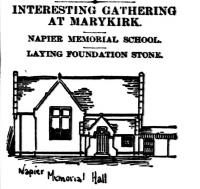
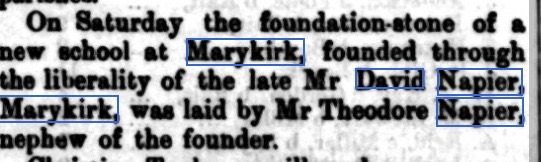
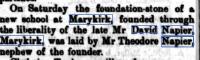
- Newspaper Article: He was mentioned in a newspaper article ON Saturday the foundation stone of a new school at Marykirk, founded through the liber- ality of the late Mr David Napier, Marykirk, was laid by Mr Theodore Napier, nephew of the founder. on 14 July 1898 at Arbroath, Forfarshire, Scotland, .8
- (Witness) Newspaper Article: He and David Napier merchant, founder of Napier Educational Trust was mentioned in a newspaper article about John Carnegie joiner, house carpenter, Marykirk on 17 October 1898. CARNEGIE MEMORIAL AT
MARYKIRK.
A MEARNS WORTHY.
The village of Marykirk, picturesquely situated on the banks of the Northesk, and a favourite resort of the disciples of old Izaak, has in recent weeks come somewhat prominently into public notice. The foundation-stone of a handsome new school, which owes its existence to the wise fore- thought of a former villager, the late Mr David Napier, was laid with masonic honours in July last by Mr Theodore Napier, a relative of the donor; and a week ago Mr Hugh Peace, who for 40 years had with marked ability filled the office of headmaster in the Parish School, was entertained on the occa- sion of his retiring from active service to dinner in Laurencekirk by a large and repre-sentative company. On Saturday after- noon & most interest-ing ceremony took place in the village -the unveiling of a lamp erected to the memory of the late Mr John Carnegie, house carpenter, who spent the main por- tion of a long useful life in Marykurk, his native village. The name of John Car-negie was as a house- hold word not only in the village and parish of Marykirk, but over a great part of the Mearns and the northern portion of Forfarshire. Aftersentative company. On Saturday after- noon & most interest-ing ceremony took place in the village -the unveiling of a lamp erected to the memory of the late Mr John Carnegie, house carpenter, who spent the main por- tion of a long useful life in Marykurk, his native village. The name of John Car-negie was as a house- hold word not only in the village and parish of Marykirk, but over a great part of the Mearns and the northern portion of Forfarshire. After leaving school Mr Carnegie was apprenticed to the joiner trade, and for a short time wrought as a journeyman in Edinburgh. Many years ago he returned to Marykirk and commenced business on his own account there. Possessed of more than average intelligence and of excellent natural gifts of an architectural kind, Mr Carnegie soon established for himself a high reputation as a skilful and upright tradesman, and acquired an extensive business, which he carried on up to his lamented death, little more than a year ago. He also acted as factor on the Kirk- tonhill and several other estates. Although his life was spent "far from the madding crowd," it was by no means a selfish or uninteresting one. Every movement calculated to raise the material, moral, and spiritual status of the village found in Mr Carnegie a zealous supporter. For many moral, and spiritual status of the village found in Mr Carnegie a zealous supporter. For many years he was a greatly esteemed member of the Session of Marykirk Free Church, and for more than a generation he carried on a Sunday school in the village. He died somewhat unexpectedly in July of last year in the 69th year of his age, leaving a widow and grown-up family, and one of his sons took up and now carries on his extensive business. Soon after his death a movement was initiated by the Rev. J. C. M'Clure, parish minister, Rev. D. A. M'Kinnon, of the Free Church, and others of Mr Carnegie's friends to mark in a tangible and permanent form the high regard in which he was held for his many works of philanthropy and usefulne-s. The following were appointed a Committee to raise subscriptions:-Rev. J. C. M'Clure, Rev. D. A. M'Kinnon; Professor Blyth, Glasgow; Mr H. Peace, then of the Schoolhouse, now of St Ola's, Dunblane; Mr Dorward, Marykirk; Mr Kait, Craigo; Mr Somerville, Edinburgh; Mr J. Grass, Montrose; and Mr R. C. Donaldson, Laurencekirk (Treasurer). A most hearty response was made to the Committee's appeal by old friends and well-wishers of deceased. The object of the Committee was not an ambitions one, and speedily a sum of nearly £50-which, if time had permitted, might easily have been doubled-was placed at their disposal. It was considered that something at once useful and ornamental would be a fitting form in which to commemorate Mr Carnegie's self-denying life. At first a proposal for an ornamental fountain was favourably entertained, but that had to be departed from owing to the difficulty of obtaining a reliable water supply.
THE MEMORIAL.
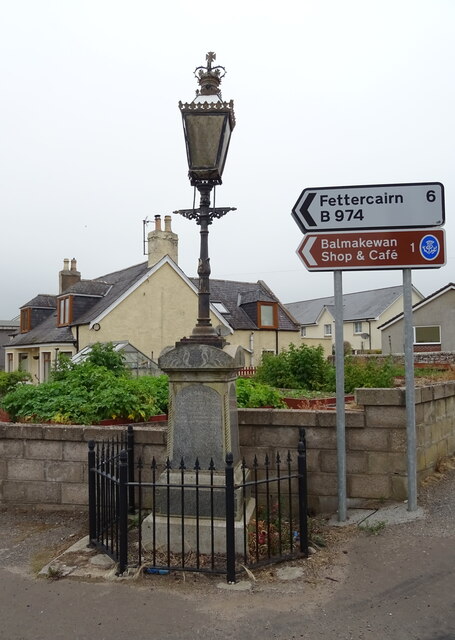
The Committee then decided that the memorial should take the form of an ornamental metal lamp, and a most suitable site in the angle formed by the branching off of the roads to Fettercairn and Laurencekirk was secured. The lamp stands on a massive polished Aberdeen granite pedestal. On the pedestal is the following inscription:- "John Carnegie, a native of this village. 1839. 1897. Erected by friends in testimony of his public and private worth." Seventeen feet in height, erected on a concrete basement, and en- closed by a railing, the memorial cannot fail to draw the attention of those who pass through the village. The memorial was supplied by Messrs Reid & Burnett, builders, Montrose, the painting being done by MrJ. J. Grass, Montrose.
THE UNVEILING CEREMONY.
The Committee were fortunate in securing the services of Mrs Taylour-Shepherd, only surviving child of the esteemed superior of the village, Me George Tailyor of Kirktonhiil, to unveil the memorial, and the ceremony was fixed to take place on Saturday afternoon. The weather was cold and stormy, and rain tell at intervals during the forenoon, but the afternoon proved dry, though bitterly eld. A considerable number assembled in front of the memorial to witness the interesting proceedings, amongst those present being-Mr and Mrs Tailyour-Shepherd and Mi-s Lyali (Hillside), from Kirktenhill House; most of the members of Committee; Mr and Mrs C. Carnegie, Post Office, Marykirk; Mr and Miss Smith, Wester Balmauno; Mr Scott, Coble-Carnegie, Post Office, Marykirk; Mr and Miss Smith, Wester Balmauno; Mr Scott, Coble- heugh, &c. On the motion of Rev. Mr M'Kinnon, Rev. Mr M'Clure took the chair, and gave ont the favourite hymn "O God of Bethel," which was heartily sung by the assemblage; and Mr M'Kinnon offered up an impressive prayer.
The CHAIRMAN then said they were there that day to commemorate one who was born in that parish and in that village, one who passed the greater part of his comparatively long and useful life in their midst, and one whose virtues they could very clearly remember. They could all remember John Carnegie, of a most active, industrions habit, a man of keen intelligence, a man of great good sense, a man who was able always to give them good advice regarding any work that they had in hand, a man of lofty Christian ideal, and, above all, a man of pare, humble, genuine, earnest, constant Christian life. (Applause.) Such was the man whose memorial they now saw. There was one feature in the character of Mr Carnegie which he could not forget, and that was his great kind- ness to the young and among the young. With them he was a great favourite. He had no doubt there were some standing there now, as there were some living elsewhere, who remembered the kindly lessons which they received from their friend in their childhood days. They had met to honour their friend, and in hououring him he verily believed they were honouring themselves. (Applause.) He then called upon Mrs Tailyour- Shepherd to unveil the memorial. (Loud ap- plause.)
Mrs Tailyour-Shepherd gracefully unveiled the pedestal memorial amid the applause of the spectator.
THANKS TO MRS TAILYOUR-SHEPHERD.
Rev. Mr M'KINNON, before proceeding to the particular part that had been assigned to him, read a few sentences from letters that had been sent by friends to indicate how widespread was the desire to do honour to their late friend, and how fitting the public regarded the particular form which that memorial had taken. These included letters from Mr William Carnegie, Sar-den, brother of Mr John Carnegie; Mr Theodore Napier; and Dr Gordon Gray. (Applause.) And now Mr M'Kinnon proceded to ask Mrs Tailyour- Shepherd to accept of their very hearty thanks for coming so kindly there and graciously un- veiling the memorial. He thought it was a peculiarly fitting thing that she should do so. She was the lady of the manor, Lecause she was the feudal superior of the village; and he was quite sure that the friend in whose memory they had erected that beautiful memorial seemed to her what he was to so many of them-a link uniting the different classes in the community one with another. He had very great pleasure in propos- ing a very hearty vote of thanks to Mrs Tailyour- Shepherd for her kindness in coming there that day. (Applause.) They wished her a long and happy life. (Applause.)
MRS TAILYOUR-SHEPHERD REPLIES. Mrs TAILYOUR-SHEPHERD, who was warmly cheered on ring to reply, aid-I am very pleased to have this opportunity of expressing my thanks for the honour which has been done me by the Committee in requesting me to unveil the handsome memorial lamp to the late Mr John Carnegie this afternoon. He was held in great respect by all the members of our family, and we felt his loss deeply. It has given me great pleasure to assist at this ceremony, particularly as the memorial is designed to keep green the memory of one of the most highly esteemed inhabitants of Marykirk. (Applause.) I wish to express my gratitude for the very hearty vote of thanks which you have so kindly accorded me. (Applause).
Mr R. C. Donaldson, after a few felicitous remarks, formally handed over the memorial lamp to the Lighting Committee of Marykirk; and Mr M'Clure, on behalf of the Committee, accepted the gift.
Mr C. Carnegie, Postmaster (brother of Mr John Carnegie), said that it was only becoming and very necessary that he should in uane of the family thank those who proposed and had so successfully carried out that unique memorial to an ordinary villager who tried to follow the Master as a carpenter and as his Saviour and Lord. (Applause) The family felt placed under a last- ing debt of gratitude by the unbounded F sympathy, kindness, and liberality manifested by what he saw before him as a mark of high respect to their dear departed one. (Applause.)
A cordial vote of thanks was, on the motion of Mr Glass, awarded to the Chairman, and the interesting proceedings were brought to a close by the Chairman reciting the last verse of the 23d Psalm.
Our portrait is from a photo by Mr Alexander Ayton, Bruntsfield Place, Edinburgh.9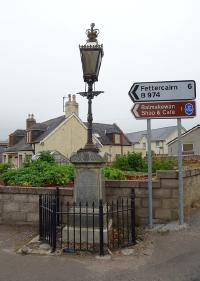 https://www.geograph.org.uk/photo/6912372
https://www.geograph.org.uk/reuse.php?id=6912372 - Newspaper Article: Theodore Napier FSA 3rd son and David Napier merchant, founder of Napier Educational Trust were mentioned in a newspaper article INTERESTING CEREMONY AT
MARYKIRK.
NAPIER MEMORIAL SCHOOL.
A pleasing ceremony took place in the Napier Memorial School, Marykirk, yesterday afternoon. The occasion was the unveiling of an enlarged photograph of Mr David Napier, the founder of the school, presented by his nephew, Mr Theodore Napier, Edinburgh. The Rev. J. C. MClure, Chairman of the School Board, presided over an attendance of school children and their parents. At the outset Mr M'Clure regretted that several of the trustees were unavoidably absent owing to their attendance at another meeting. In the course of his remarks, the Chairman said they were glad to have something to remind them of the late Mr David Napier, who took such an interest in his neighbours, and especially in the young. He believed it was a sorrow to Mr Napier that the little children of the village and neighbourhood had to go so far to school, and this had prompted him to provide for a school in their midst. Mr Napier had a kindly feeling towards the bairns, and it was a blessing to them that in his last days he showed his practical interest in them. He (Mr M'Clure) referred to the kindness of Mr Theo- dore Napier for sending the photo. of his late uncle. He hoped the young people would occasionally turn their kindly gaze upon the features of their benefactor. They were each indebted to Mr Theodore Napier for his kind- ness and he would be pleased to inform him. that their meeting had been a very pleasant one. Thereafter Mrs M'Clure unveiled the picture amid loud cheering. Mr Charles Car- negie gave some reminiscences of the life of Mr David Napier. They were, he said, much obliged to Mr Theodore Napier for his kind- ness, and he hoped the photo. would be an inspiration for the children to do something for their parish and village, if it ever were in their power to do so. Mr David Napier, the founder of the school, was a man of integrity. He left all his means for the public good, and a great benefit had certainly been derived by the village and parish of Marykirk. The schoolroom was a comfortable one, and was utilised for many purposes in connection with the social life of the village. On the frame of the photograph was the following inscrip- tion" David Napier, founder of this school. born 1799, died 1885 presented by Theodore Napier, Magdala. Victoria, Australia."
At the close, Mr David Playfair moved a vote of thanks to the Chairman for presiding. and Mr M'Clure suitably replied. on 14 March 1902 at Marykirk, Forfarshire, Scotland,.10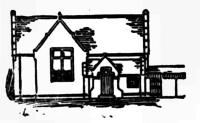
- (Witness) Newspaper Article: Theodore Napier FSA 3rd son was mentioned in a newspaper article about David Napier merchant, founder of Napier Educational Trust on 30 September 1927. NAPIER SCHOOL, MARYKIRK. David Napier, founder of the Napier Trust and School, Marykirk, was a native of the parish. He served his apprenticeship as a joiner in the village, and, with the exception of a short stay in London, where he worked at his own trade, he lived all his life in Marykirk. Born in 1799, he died in 1885, at the age of 86 years. After his return from London, he opened a grocer's shop, which he managed with success, leaving a good deal of money and house property in the village. He was never married. In his will he left his whole estate, money, and property for the building and main- tenance of a school in Marykirk village. He directed his trustees to tend the houses nd gardens in Marykirk, and the proceeds of the remainder of his means and estate, until the rents of these subjects, and the free proceeds of the remainder of the trust estate and the annual revenue of these, amounted to the prin- cipal sum of £3500. On that sum being reached a school, with suitable offices, was to be erected. The trust funds, exclusive of the value of the existing houses and gardens, reached that sum in 1897. After deducting the sum required to build a memorial school, at a cost say of £800, as also feu-duties and main- tenance, a sum of about £95 per annum is available for educational purposes. Now that free education is the law of the land, the trus- tees, with the approval of the Court and the Education Department, resolved to place the Napier School under the management of the School Board, and to erect a school for infants and scholars in the First and Second Stan- dards under the management of a day qualified female teacher, to offer the School Board to keep the Napier School and offices in good order,! and give the Board the free use of the school during ordinary school hours, and for a period of 15 years; and to pay the School Board the surplus revenue of the Trust funds for payment of the teachers, &c.11
- (Witness) Wiki: Theodore Napier FSA 3rd son was mentioned in the wiki entry https://en.wikipedia.org/wiki/Theodore_Napier.12
- (Witness) Note for Web: Theodore Napier FSA 3rd son and John Myers were mentioned with Sarah Napier and John Myers farmer & Colonial Pioneer. Sarah Napier, born 1788, married John Myers, farmer, of Marykirk, Kincardine, Scotland. Their eldest son, John Myers, 1819-1936. came to Melbourne in 1843. In 1847 or 48, he started farming at Merri Creek and in 1856 he purchased crown land in the Pentland Hills for 15 shillings an acre; there he bred Clydesdale horses and dairy cattle. He took a signific part in having the Presbyterian Church built in the Pentland hills - a beautiful little sandstone building; it stands beside the Western Highway.
Descendants of his large family bear the name of : Myers, Plummer, Gibson, Lester, Charlton and others. They live in suburban and country districts, particularly in the Ballan and Bacchus Marsh countryside. They recognise the early link with the Napier family and Theodore Napier was well known by them.13 - [S40] JF via MyHeritage and email; also 'The Barber Chronicle' book detailing the Napier & Myers families of Marykirk and Australia among others [May 2020].
- [S67] Website findagrave.com (http://www.findagrave.com) Find a Grave, database and images (https://www.findagrave.com/memorial/165236550/david-napier: accessed 7 April 2024), memorial page for David Napier (8 Nov 1799–13 Sep 1885), Find a Grave Memorial ID 165236550, citing Marykirk Kirkyard, Marykirk, Aberdeenshire, Scotland; Maintained by Jackie ABC (contributor 48218483). [Apr 2024]
- [S54] Website findmypast.co.uk (www.findmypast.co.uk) Newspapers & Periodicals collection Montrose, Arbroath and Brechin review; and Forfar and Kincardineshire advertiser. 27 July 1888 [Jun 2020].
- [S49] Website Web Site online (www.) https://trove.nla.gov.au/newspaper/article/139141996?searchTerm=jessie napier - The Australasian (Melbourne, Vic: 1864-1946), Sat 30 Aug 1890, page 50, Family Notices [Jun 2020].
- [S32] Newspaper Article, Montrose Review 26 March 1897 [Apr 2024].
- [S32] 1898 Napier Memorial School at Marykirk Montrose Review 24 June 1898 [Apr 2024].
- [S32] 1898 Interesting Gathering Dundee Courier 11 July 1898 [Apr 2024].
- [S32] 1898 Napier foundation stone at Marykirk Arbroath Herald 14 July 1898 [Apr 2024].
- [S32] 1898 Carnegie memorial at Marykirk Dundee Courier 17 October 1898 [Apr 2024].
- [S32] 1902 Napier Memorial School at Marykirk Montrose Standard 14 March 1902 [Apr 2024].
- [S32] 1927 Napier School Marykirk Montrose Review 30 Sept 1927 [Apr 2024].
- [S29] https://en.wikipedia.org/wiki/Theodore_Napier [Apr 2025].
- [S49] Website Web Site online (www.) https://books.google.com.au/books?id=wrMbGY3_K6MC&pg=PA64&lpg=PA64&dq=Sarah+Myers+born+Napier&source=bl&ots=KR788P1y_i&sig=ACfU3U0ie8IkLmkT9613uwdj1ubgAUXQkg&hl=en&sa=X&ved=2ahUKEwifkfG48tfpAhWHbisKHbJXCLgQ6AEwAHoECAkQAQ&#v=onepage&q=Sarah%20Myers%20born%20Na&f=false [Jun 2020].
Theodore Napier FSA 3rd son1
M, #16839, b. 29 March 1845, d. 29 August 1924
Last Edited: 14 Apr 2025
Parents:
Father*: Thomas Napier carpenter to Australia1 b. 18 Jul 1802, d. 7 Feb 1881
Mother*: Jessie Paterson1 b. 1816, d. 28 Aug 1890
Mother*: Jessie Paterson1 b. 1816, d. 28 Aug 1890
Relationship:
1st cousin 4 times removed of Patricia Catherine Adamson